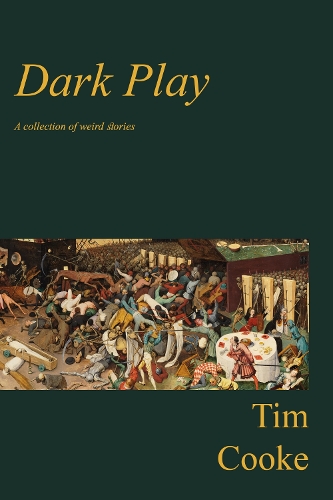
There’s a real thrill to a well-deployed epigraph, particularly when it’s a theoretical concept used to set the stage for a work of fiction. For a particularly excellent example—of both use of epigraph and work of fiction—look no farther than the chapbook Dark Play by the Welsh author Tim Cooke. It opens with an extract from the American theatre director and performance theorist Richard Schechner’s The Future of Ritual. Schechner’s concept of “dark play” is a mysterious set of circumstances that occurs “when contradictory realities exist”, whether players (in the sense of games and performances both) are all conscious of it and colluding or one is working alone, conscious or not. The quote ends noting that dark play “subverts order, dissolves frames, breaks its own rules…” The ellipsis is Cooke’s, not Schechner’s, but that’s key to the affect of the excellent work on display here. This book—six short stories, each preceded by a brief interstitial—exemplifies the use of vagueness and productive ambiguity. It lives, in other words, in the ellipsis as much as the words.
Five of the six stories center on a father and daughter living in isolation on a remote mountain after a tragedy (the other, the final story in the collection, is titled “Mother”, which might give you some hint as to the nature of the tragedy). Each is preceded by a brief untitled vignette drawn from the bloody, ill-fortuned history of the mountain, which introduces the thematic material of the story to come. The unsettling events of each story tend to straddle the line between story and game, the child a haunting, somewhat eerie presence, constantly lost in imagination. The second vignette, about a woman lost in the woods, leads into “The Visitor” and resurfaces there as a story about a witch told by the father; the daughter is “fascinated by any hint of horror”. The arrival of the titular visitor, a lost young man, leaves the father “disorientated, stranded between two worlds, unsure as to which was real”, but he still tells the daughter, as part of their ongoing games, that this must surely be the witch in disguise. Events unfold from there, but does the daughter truly believe in the witch, or is she justifying her suspicion of an interloper, or is she playing games upon games?
In “The Judgment”, the girl sees—or pretends to have seen—a group of women, possibly ghosts, and begins to worry that they know where she and her father live and are here to punish them for some kind of transgression. This comes after they visit a nearby pub with a history stretching back hundreds of years, billed as “one of the country’s most-haunted buildings”. There the father notices graffiti reading “the guilty must pay”, which he interprets as a bit of inauthentic mood-setting. Is it actually a message from ghosts? Did it give the daughter a clever idea for a haunting game, or is she actually as worried about the father’s mysterious guilt as she comes across? It builds to the incredibly ominous final paragraph:
I think they’re coming for you, Dad. She slid down the front of the chair onto her knees, her spine arching hard against the angle of the cushion. They’ve come, she said. They’re here.
A striking example of Cooke’s pared-down prose, it’s not an ellipsis, but it’s as good as, especially given the fact that many of the stories here end so ominously, but their events are never mentioned in the others. Indeed “Mother”, the only one we can situate chronologically as the earliest of the sixth, is the one that closes the book. “Mother” also makes clearer than any of the other stories that the daughter’s game-playing is learned, driven as it is by the dad encouraging a game of hide and seek that goes wrong; “You and your fucking games”, the mother scolds him. Otherwise, there’s no clear chronology, no narrative throughline, none of them building on the others, which adds to the haunting, cyclical feeling of their isolation. This feeling is bolstered by the fact that most of the narratives build and then cut just before climax or denouement. This cyclical nature, unresolved, tied with the historical nature of the interludes, leaves one with the feeling of a spiral, a loop, that you see only pieces of. Perhaps we might as well read them as Schechner’s contradictory realities, these stories all as different aspects of one another; not chronological anecdotes but glosses on a paired life lived weirdly. “The Visitor”, again, is particularly noteworthy in this regard, ending with a coda that makes no reference to the shocking climax of the main narrative; the father and daughter out for a walk, eating apples, she telling him that she doesn’t fancy a walk but wants, instead, another story.
There’s also little need—and perhaps, not much room—for an overall chronology within the stories to intrude because Cooke is so fixated on the external, historical chronology of the region. The history of violence that might infest the mountain similarly infests the very structure of the chapbook, the preludes drawn from that history, full of implied violence, righteous rage, futile attempts at justice. The farmhouse itself was built in the eighteenth century and the father “couldn’t help thinking that terrible things must have happened here over the years. It was so isolated, so exposed to the elements. The loneliness must have been awful.” Like literature’s most famous haunted house, we might note that no live organism can continue for long to exist sanely under conditions of absolute isolation. This weight of the past is contrasted with the youth of the daughter; the father finds it “painful remembering her as a baby or toddler, now that she was growing up. Everything had been so all-consuming, and the innocence of that time, her purity, had restored something in me, almost like a kind of forgiveness—a state of grace, even, or a stay of execution.”
As Schechner notes in the epigraph, dark play “can erupt suddenly,” seizing its participants and then “quickly subsiding”. Dark Play’s unsettling-by-implication weird fiction does exactly that, erupting into an almost state of productive ambiguity before subsiding 67 pages later.
Zachary Gillan (he/him) is a critic of weird fiction residing in Durham, North Carolina. He’s an editor at Ancillary Review of Books, the book reviewer for Seize The Press, and his work has appeared in Strange Horizons, Los Angeles Review of Books, Interzone, and Nightmare Magazine, among others. He can be found at doomsdayer.wordpress.com and @megapolisomancy.bsky.social