You were a great starspeaker. You weren’t one of the best.
Once, you mistranslated a location and directed a haughty emerald comet into an icy sea, where it obliterated three islands, inhabitants, limestone, glacier tears, and all. Another time, you argued with an invading meteor shower instead of deferring, so they turned their blaze on your tower. They scorched your arms off. That wasn’t your first razing, nor your worst, physically or diplomatically. It wouldn’t be your last either.
You were always ahead when it came to destruction. The stroke took your arms before meteors crushed them off; the war took your home before the Starspeaker Society evicted you; your tongue vanished half your friends before stars killed them. You struggled with tact long before tower debris smashed memories and clarity out of your head. Such is the curse of multilingualism. Of knowing too much in a frame too inadequate for it. I avoided conceding to you in any language. Despite others’ praises, you were no diplomat at home.
It’s still admirable that nothing short of a comet’s wrath could pause you.
***
When I was a girl, you stood atop the burnt, black briar finger of a tower, a dot, your new iron arms aloft, your robes and tongue curling in welcome, a prismatic meteor of many eyes greeting you. You held a planetary rainbow apocalypse in your arms. Dad boosted me on his shoulders far below. Everyone else hid in caves. Our community never watched you work. They believed it was bad luck. Not us. We waited on a hillside punctured by star teeth, grass, and broken light blades.
No one can win against your mother, Dad said, mostly in admiration then.
The star addressed you. It grinded, it crackled, it spit, it hissed; it groaned as much as it shrieked. In star-language, ten demands could explode from a visitor simultaneously, long sounds radiating outwards like blades in night, similar but distinct, all joined at one nucleus of want. It could also take an hour for one sentence. Time meant nothing to these travelers of eternity. I watched you debate with extinction in labyrinthian starspeak.
I watched you prevail.
Unflinching, you relayed the star’s wishes to assistants below. They braided a chain of daisies a league long, then crowned our visitor via falcons. The star turned away, ribbons of aura borealis in its wake, ash composed of wishes and cold snowing below it. It returned to space. You returned too: you descended those thousands of stairs to us. We all deserve kindness, you said.
I feared your raised voice for years.
***
You, a dedicated starspeaker, loathed that I wanted to be one too.
Even after divorce and the Summer of Blood Stars, you were concerned about status. About stomach. You disregarded the flaming sheep flocks plunging into sinkholes like fireballs of debt, although you’d sobbed over far less; you dismissed the concept of anyone—you included—foiling the cataclysm these travelers were bringing on fiery tail-wing. The world stood to end any day, but I wanted discomfort; you’d worked years to tow autonomy into my universe, yet I aimed for the intimate worst.
No one knows what starspeakers do, you told me, until they do it wrong. Then ah! Everyone can speak to stars. It’s so easy. People always come and smash you with their words. Even here. You’re too sensitive for this job. Go ahead! Keep killing me with your eyes! It’s true.
Be something worthwhile, you told me. Not this. Make money. You think you’ll be famous? You won’t. The Society won’t pay you anything. What happens if you die? Who will take care of your father? Do you hate us?
Then: I won’t help you.
I escaped you. I hitchhiked by serpent ferry and cart—ignoring warnings, laughter, and snorts of dismissal—until I washed into a lighthouse. Here, professors still dressed students in glittering robe galaxies and taught old ways in spinning observatories. Here would be people that knew every action mattered. Here were people too educated for pessimism or doubting our importance. People above you.
You sent me money anyway. You drove Dad insane: when the local confectioner didn’t have my favorite candy, you insisted on walking to another town to buy it, then wasted a whole day fretting over postage for it. You disapproved in silence while filling my mailbox. Society falcons always arrived fat with little gifts for me. They bolstered my spirits as I beheld the dilapidated state of the university. I tasted copper coin ridges beneath my tongue. No wealth that we protected trickled back to us. My assistant work was plentiful, my pockets empty.
I saw you in my astral patterned sleeves. In my poor study habits and scoffs at peddler prices of fruit. I heard you in myself as my disillusioned litanies echoed off those bronze planets. After an asteroid annihilated you, Dad forced us into scrying, and with new comparisons, I saw your degradation. Even your shrunken visage in the seeing mirror looked horrible. Dad had to hold it up for you. He also had to draw out my calling glyph: you couldn’t remember it. You’d been burnt-torn asunder. Even stranger: you were curled against my father without complaint.
You didn’t complain when the Society demoted you either.
Did you ever learn that I failed an astrology exam because, instead of studying, I spent all day screaming into a scrying mirror at the Society for evicting you? That would’ve enraged you. It didn’t matter that the Society retired you while still begging for your work. Though you never approved of my education, you approved of my reaching for excellency, regardless of what it cost.
I burnt bridges for you anyway. I almost got blacklisted for threats. I took a semester off to transition you into Dad’s house, ordering neither of you to ignore healer orders for efficiency, knowing you both did. Dad collapsed once. In the aftermath’s aftermath, you remembered none of your pain or ours. Only fire.
To you, perhaps that’s all there was.
***
When I was between childhood and adolescent maturity, the age that broke you, the sky fell. Nebulae disappeared. Constellations writhed towards us. The night blackened. No walls could mask the screaming you did as your friends winked out on your shared tower, one by one. It took months. It felt longer. New, unhoned starspeakers dove into their places; replacements were needed faster and faster. Starlight mimicked dawn so often that Dad and I lost track of the sunsets. You never forgot. If I didn’t keep my curtains closed at night, you berated me, especially when you had work.
Don’t look at the tower. You clenched my arms with metallic claws. Okay?
You used to let me. What’s wrong now, huh?
Don’t be stupid with me! You shook me. I brought you into this world. I can take you out of it. Don’t watch me. You understand?
I did.
I stole Dad’s spyglass from his war chest. I doubt he knew. It was covered in cobwebs. He had a much nicer spyglass from your engagement. Even when you slept separately, he watched you. We never did it together. Parallel secrets were better than giving you a united front to assail.
The visitors that arrived in those months shone with violence. We named that season the Summer of Blood Stars. They came in war parties, cavalry and chariot animals at once: golden meteorites wreathed in pinwheels of slashing arms. Comets bristling in reeky clouds of sulfur hellfire. Comets born screaming. Asteroids swinging maces of raving moons spiked in dark matter and chained in elliptical orbit. Showers of afterbirth from time’s origin, turned sentient and rotten. Prayers of annihilation armored in gas.
You stood in front of them all.
When you couldn’t convince them to leave, you bore the price, or convinced them to crash elsewhere. Mostly, the ocean. Mostly. I cleaned strangers’ spit vitriol from my face many times. If you asked about my mood, if we didn’t argue, I’d lie, and claim that the heartbreak was about love. That’s because your taste is bad, you’d say. Soldiers ringed our town until autumn. The schoolhouse’s roof leaked from all its repaired stoneshower holes. Our house festered in graffiti. Acquaintances bountiful with acceptance later flashed starvation on their sleeves.
The visitors weren’t better. Once, a disobedient comet slammed into our plains. Charcoal pronghorn skeletons littered our hills for weeks. Everyone was excited for soupbones. People danced in the streets. They forgave you for your failures. You cried on our threshold until Dad carried you to a seat.
I asked the comet not to do that, you said. Oh, babies, I’m sorry. I’m sorry.
It’s sad, but they’re just animals. You did the right thing. Dad mechanically combed your hair.
They didn’t know what was happening. They were so afraid.
Over the next weeks, I watched weather and opportunists erode the pronghorn away like dunes under wind.
Soon, they were gone.
***
My father died the night of my first colossal failure.
For whatever reason, you were convinced that I knew that. How, I’m unsure. Your stone-broken thoughts must’ve told you that my presence was possible. While my father hemorrhaged in your kitchen, I was on the lighthouse roof, a frozen new graduate, five hours deep into negotiations with an asteroid.
This asteroid was agitated. Flighty. It glowed grey. Its voice was a clattering of petrified bone, its smell of moldy elk hair and electricity. It existed as infinite boiling dots around an ancient chunk of earth. A diasporic son from our moon-making collision. A phantom.
LET ME REJOIN, it demanded every half hour. LET ME SEEK-REST-SHATTER-SPREAD.
Not here. I struggled to direct it. I wanted the asteroid to plummet inside the nearby marine trench, not on the coastline. It didn’t understand me. Its words branched too far, mine too short.
The asteroid’s presence forced the tide from the lighthouse, revealing a tonsure of algae-slick, star-scared rock where waves should’ve been. It also stirred ghosts in our atmosphere. Pigeon forms flocked around the asteroid in the billions, broken by mammoth gaps, branching antlers, humpbacked and horned outlines, and slinking sabertooth shapes. Paleolithic migraine-makers. Patterns of thickened dots in the mist.
WHY? Again, with more impatience. END, SOON. IN THREE CENTURY BREATH. LET ME SEEK-REST-SHATTER-SPREAD.
In hindsight, I knew what syllables slipped in my reply. I meant to disagree with the concept of our demise. Instead, I asked for a breath of extinction.
The asteroid swiped my arms with its sandpaper body-teeth. Everything below my elbow turned to burnt matchsticks. I tumbled back into the tower, into my colleagues’ urgent arms. The asteroid wheeled into the sky. I was half conscious in a Society medical cot when you scryed me, furious, self flagellating.
He’s dead, you kept saying. He called you. Why weren’t you there?
It took three days to unjumble your words. The blame was clear from the start. The logic never clarified. You might as well have been the asteroid.
***
Back during the worst nights of the Summer of Blood Stars, you gestured at the malevolent heavenly hum that enveloped our Society house, that underskin whispering of black holes, and said, This is what we heard growing up in my country. This but louder. They crushed mountains. They burnt rivers out of the ground. I saw my neighbor headless. He was a starspeaker too. He inspired me to be one. ‘We can fight for better,’ he said. ‘Better is possible.’ He’d learned from his grandfather. My family spent all their money sending me to star-school. They became poor for me. ‘How are you working but homeless?’ That’s what my family would say, before money stopped mattering. They didn’t understand. The stars killed my neighbor. They dropped him on his roof. He got stuck in the poinsettia tree. His family starved. Good people never win.
Everyone has it hard, Dad said, pointedly.
I learned, then, that you were an abomination. A person born only to suffer. I prayed to the stars killing us to be better than you. Give me her backbone, I begged them. Give me her power. Burn the rest out of me. Every night you weren’t assaulting yourself, me, or my father—and some nights that you were—you negotiated celestial bodies back into the sky. No failure silenced you. No success satisfied you. Stars lived off fumes; so did you.
All to delay the inevitable for one dog-eared corner of the universe.
***
Although I shattered my scrying mirror after the funeral and disowned you—hurled its shards into the ocean, knowing that once again, you lay on the floor wailing, your attempts to reach me drowning among a seasky of creatures and shells—I couldn’t hide from my reflection.
I resembled you more with every failure; I resembled you tenfold with every success. With every win, I craved another. Nothing but the excruciating righteousness of defiance completed me. What I learned came less from guidance than from watching you: your steadfastness, your adaptations, your resilience. Everything that made you a horrible mother in proximity, but a brilliant one from a distance. Polaris. You couldn’t teach me happiness because you did not know it. That didn’t mean it was undeserved.
Right after I disowned you, I started pinching lit matches between my iron fingers. I watched them burn until they extinguished. It brought no sensation. As a child, I’d never asked you how losing your arms felt, or how bearing starforged arms did. You made it seem natural. Neither you nor Dad were interested in explaining your individual night crying.
Did you think your intervention was stealthy? My limbsmith told me all about your constant scry-calls: your threats, your pleading, your unwanted advice on smithing, your arrogant opinions on what star-flesh to use, your encyclopedic knowledge of every arm ache I’d ever had, your rambling about lifelong ailments. Your limbsmith hadn’t believed you when you’d said your prosthetics were too tight. She’d said that you’d get used to it. You had deferred. You’d rather die than apologize to me; you’d go to war before you let me experience a sliver of your agony.
You didn’t deserve to be in my life. Nonetheless, you loved me. You didn’t break yourself for my security to prove a point. Even if you did that too.
***
When I neared middle age, I’d spent years pleading with stars atop towers of my own. The universe was no brighter. No better. I didn’t sleep. I recited past negotiations against my blankets, tasting traces of infinity. Any successes felt small. Mistranslations haunted me. The craters around our light-bleached lighthouse urged the ocean to come closer, as if it carried your advice, or your admonishments. Your comforts, too. We were both half metal by then. Oftentimes, it hurt. I better understood your moods.
My dreams were repeats of waking experiences: stars resplendent in anger, grinding out warsong between obsidian teeth. Stars edged in wildfire, requesting audience to their operas. Stars pitted with galactic ancestor bones begging for graves. Stars that were many, tiny, and purpled in hot envy. Stars pocked in luminescent faces looking for friends long sealed in our core. Stars that were diamonds. Stars that spoke-hissed in riddles. Stars that sought enemies. Stars wielding swords made of kin. Stars that craved explosion. Stars glorioled in hatred and secrets of our future demise. Stars; stars; stars.
How you birthed me was beyond me. I wasn’t strong enough to follow suit in parenthood. You must’ve had a vision, to face all that vast entropy hidden from my father before agreeing on a child: a dust mote useless to the universe, but priceless to you.
You must’ve been lonely.
The neighbors said that now, you don’t eat more than a breadloaf a day. They said you go on walks with their grandchildren—none of whom you name or gender correctly—nap, and garden, growing basil, radishes, and a reputation for sweetness. I laughed at that so I didn’t fume. None of those children know you as I’d known you. You’re a senile celebrity to many that cursed your name.
The neighbors said you talk about me with every other breath. They said you’re miserable. When I drew your symbol and scryed you for the first time in years, you picked up immediately. It took you three calls for you to admit anything disruptive had ever occurred.
I didn’t want to scare you away, you said.
***
You needn’t tell me that you’re dying. I know.
It’s far too late for us to be speaking weekly over a scrying mirror. It’s far too late for me to move home and fill your old position—the young starspeaker that succeeded you just died; the others fled; demand is high, interest low—and far too late for humanity. I don’t tell you that meteors repeat what they have for millions of years, or that the rotation of our planet remains the same in doom or in hope; you don’t ask. We’re both aware.
You swing us close to disaster when you say, I knew that if you turned out anything like me, all of this would’ve been for nothing. Just look at you.
You veer us away when you say, I hoped that you’d have a better life than me. It hurt worse than falling to know you didn’t. I wanted to make the world better for you.
You did, I say.
I didn’t make it better for those pronghorns, you say. Poor babies.
You repeat that part often. You’re unapologetic otherwise.
Admittedly, I never apologize either. Not for what matters. Securing a future for your child might’ve been your dream, if not your duty, but what of mine? I failed to make a world you could grow old in. Since I was supposed to carry us forward, I cannot imagine anything worse. You crossed continents to escape the unthinkable. Now you’re dying in it here. The sky blackens more every decade; the stars seethe.
But, finally, I can bear to hold your iron hand in mine. Whatever you do in your final failing, brilliant crash, I can forgive. Those who have spoken to stars owe each other some perspective. None of us matter: not you, not me, not the millions on this dying dot, not the millions gone, not motherlands unwritten. We all return to the spine of space.
I’ve discovered a helpful trick: if I hang your old robes over the windows, you mistake their lining for reality. You think the stars are resting. Each time the galaxy crawls towards us, I close the curtains, alert the neighbors, then ascend your rebuilt tower. I bargain for what I can, the silhouette of your vaporized atoms under mine. You’re oblivious.
There is no little girl watching me to twist terrified excellence out of me. But you’re practically a child now. Rabbits and babies make you cry. You ramble about obliterated mountains in your first language, and whine for permission to splash in dead, distant rivers. You’ve started calling me my father’s name, or your father’s name. Sometimes the names of stars. You’re unaware of all that’s replaced by brainfog or forged starshine, so you’re slower than you believe. This is helpful: you’ve never been so peaceful. I’ve never managed you easier, or found it so hard.
When I grow up, I want a daughter, you say. Do you think I’ll be a good mother?
Yes, I say, I do.
***
When you die, I hold your wake at sunrise, even if the red sky implies no more sunrises are coming. I checked the time on a watch. I know it’s daylight. Half the town comes. She was vicious and constantly in pain, I say to everyone; It’s a relief that she’s gone. Then I pad that harsh nucleus with a soft, long-tailed body of stories: everything funny you did, every day you won, the heat at which you cared, the eternity I’ll miss you. Acquaintances euthanize their last grudges. Thanks never uttered to your ears shower your memory. I spread your ashes over the now-scorched grove that covers Dad.
Towers are falling again, starspeakers vanishing. We are furthest from hope in orbit now. We may never return. Despite the futility, I continue. I lie to the neighbors’ grandchildren. I tell them they can be happy; I tell them we have a chance. I send funeral letters and birthday cards on falcon wing. Without prosthetics, my body ceases working. I never do. If I’m tempted to, I remember you. I keep speaking to stars: the haughty emerald comets, the displaced crimson invaders, the scheming sapphire meteorites, the grieving silver asteroids.
We’re already lost, I tell them, but that doesn’t matter. You want me to move? Make me.
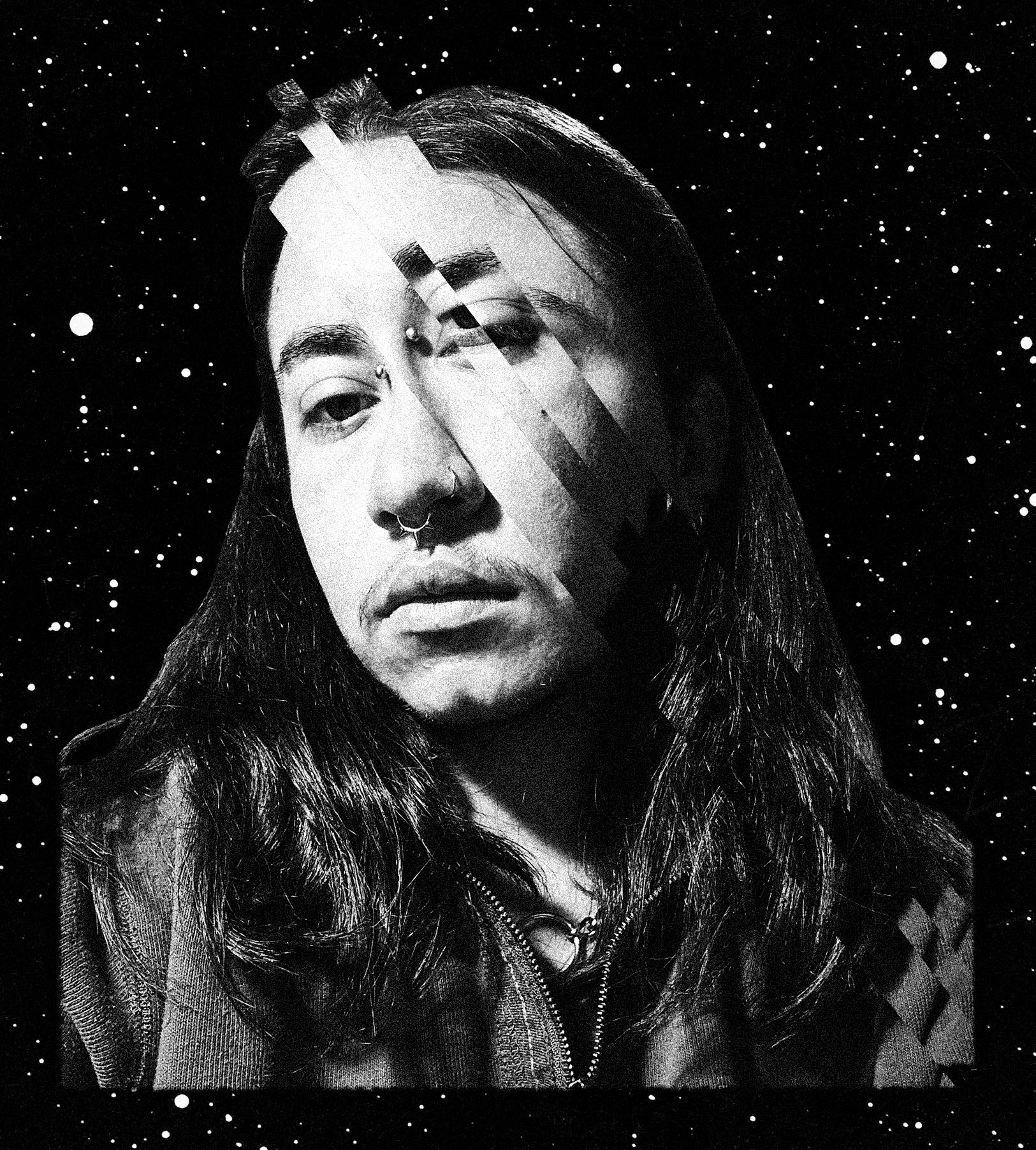
Samir Sirk Morató is a scientist, artist, and flesh heap. They are also a Brave New Weird 2025 winner and a F(r)iction Fall 2022 Flash Fiction finalist. Some of their published and forthcoming work can be found in X-R-A-Y, ergot., NIGHTMARE, and The Dark. Their short story collection “Gore Poetics” (Cursed Morsels Press) emerges April 2026. They are on Bluesky and Instagram @spicycloaca.