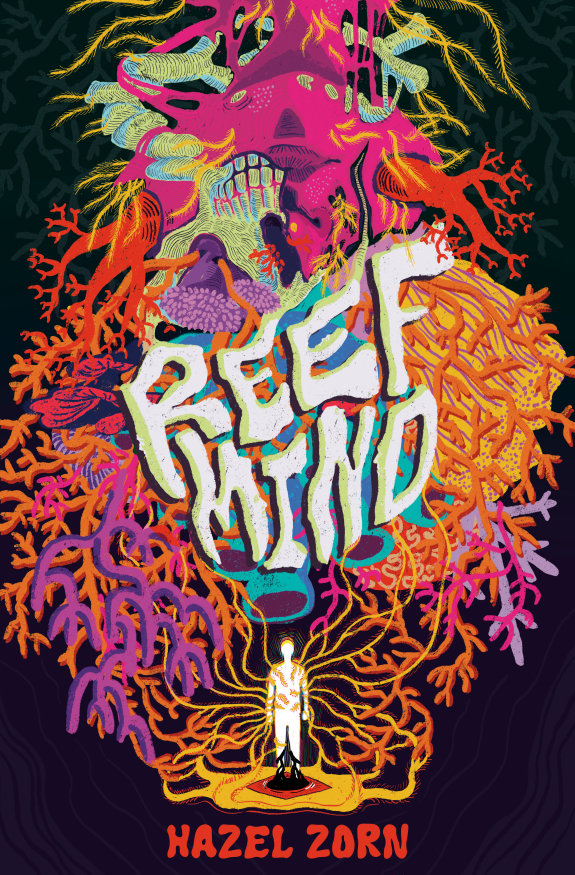
Hi Hazel, thanks so much for chatting with me; I just read your recent eco-horror novella Reef Mind and thought it was sick. In the book, the land is invaded and colonised by coral, which has migrated out of the ocean and either killed or assimilated most of humanity. On a broad level, how much does the book reflect your own anxieties and foreboding about the future of the natural world, and perhaps the seas in particular?
Hey Jonny, I’m so glad you liked the book. Broadly speaking I approach the natural world with an open mind and an eye for beauty. The earth has everything essential for human survival. And we can thrive together, even live as a family. But when nature is mismanaged by ruthless exploiters, I feel that the human race is betraying itself. That is what makes me anxious, what makes me grieve. I deliberately mirrored the worst human characteristics in the coral. In the book, it dominates, exploits, and seeks to totally control all life on the surface. It seemed appropriate that we’d meet our match in something we don’t fully comprehend: the ocean and all that is contained in it. I will never scuba dive. I don’t even like being on boats.
Do you have a particular interest in coral? I remember we used to hear a fair bit about the danger coral reefs were in, but it seems like it’s largely dropped out of the conversation when it comes to ecological hazards, and I don’t think I’ve ever seen it as a driving force in a horror story.
I’m not a scientist but I am an artist, and one of the lessons I learned at the atelier is that artists reveal what nature hides. We’re taught to deconstruct an object first, to understand it abstractly before attempting to render it. It’s like training your brain to build invisible scaffolding. The reefs are responsible for producing oxygen in the atmosphere, so imagine what comes tumbling down when that scaffolding is destroyed. They’re also beautiful and bizarre, not quite rocks but also living flowers. For me, it is enough that they are beautiful. Nobody has the right to destroy a beautiful thing. The corals are irreplaceable.
It struck me when reading the book that you must have a deep awe at the sheer power of nature. Do you think we don’t respect that enough? What do you think about the complicated question of whether we as a species have mistreated the Earth versus how much of it is down to a relentlessly profit-hungry economic system that only benefits a minority of humanity?
Oh yes, nature is awesome. And while I think the problem is both, that our economic system has outdone the natural evil we can’t always avoid. By natural evil, I mean the kind of thing nobody can help. The eruption of Mt. Vesuvius. Childhood cancer. The tragedies that can occur without warning. That’s just life. But our economy is immoral. And moral evil is what we’re doing to the earth, and therefore to people. I see a barbaric practice of privatizing natural resources, which forces entire populations to go without basic necessities. Or that we’re all suffering from what used to be once-in-a-hundred-year weather events more frequently now, events that devastate communities because of human-caused warming trends. We’ve made it harder to live on the earth than it should be. If we took on more responsibility for the stewardship of nature, we could face the unavoidable tragedies of life with actual comradery and dignity.
One of the stylistic choices I loved in the book was in the moments the characters looked back on important moments in their lives and often found their memories were faded, lacking, and imperfect. It’s always a bit disappointing to me when a writer thinks the point of fiction is to impart factual information of events that have (fictionally) happened. What we often get in Reef Mind is patchy recollections of events that neither the characters nor the reader can really trust to be accurate. What does this reveal about your broader approach to storytelling?
I like writing weird fiction which characteristically eschews certainty for the sake of dwelling on uneasy feelings. As I get older, I often reconsider my past views and actions with mixed feelings. I don’t know my future yet, so I think I tell stories because I don’t know what the end of my life will look like. It’s hard not to contextualize what came before by the current moment, the current hermeneutic. I don’t think it’s lying, but we’re all trying to understand why we even exist.
Given the horror and deep trepidation about the future in the book itself, Reef Mind has possibly the most touching acknowledgment I’ve ever read. You thank your husband and write “I’m comforted, knowing that I face the uncertainty of the world with you”. That genuinely made me tear up and I wondered, despite it being very easy to be pessimistic about the future in so many ways, where do you think we can find things to make being here meaningful and worthwhile?
Thank you for saying so, I really love my husband. I believe that while the world is an uncertain place, this realization should not foster outright despair. I deliberately discipline myself into hope. I don’t want my anxieties to cripple me, I want them to call me to real action. That’s love. Why ever give up on love? If I’m making a mistake, let it be an error of love! That’s my advice.
You’re also a working artist working mainly in oil paintings. I’ve got to say, beyond reading John Berger’s Ways of Seeing once when I was trying to impress a girl, painting is something I know very little about. How did you get into it and do you have a particular style or tradition that you work in?
I’m an oil painter. I’ve wanted to be an artist since I was a little girl, but I grew up in a small town with only two colleges. Their art programs produced graduates with portfolios full of Coca-Cola ads. So depressing. I put artistic dreams on hold and acquired a degree in Classics instead.
Then, after college, I moved to Boston and found the perfect art school: a French Atelier. I specifically learned traditional French and Italian methods of realist art. Now, I work as a Fine Artist and I paint still lives, florals, portraits. It is an art form that rewards intensity and patience. Characteristics, I find, that lend themselves to writing books.
A little while back you wrote an article for Blood Knife (now sadly on indefinite hiatus) about the need for artists to collectively resist the rise of AI image generation. Two years on, how do you feel about how the technology has progressed and the collective response of artists of all kinds?
I’d say my hate has intensified! AI art is garbage. Like jangling keys in front of rubes. I honestly feel like I’m witnessing some sort of mass psychosis with this stuff. The best use case for an LLM is a more efficient search engine tool. It can summarize information, for instance, but even people using it that way have to review the output and synthesize it. (This information comes to me from lawyers and software engineers I know.)
There’s absolutely no good use case for it in the arts. Artists (in the US at least) are employed as individual subcontractors or on commission. This means that there aren’t a lot of guilds or unions, unfortunately. The image models are also violating copyright law on a mass scale, and that’s how artists make ends meet under capitalism.
I can say, this issue has brought artists together in ways I haven’t seen before. Collective lawsuits, advice, and strategies are all much more publicly available. There’s also cross-solidarity with other creative workers in publishing, for instance. We just have to keep fighting for our dignity. There’s no other option.
In that article you talk about how “the broader fight over technology under capitalism is a fight between the capitalist and the worker, fueled by conflicting motivations for technological advancement”. In any rational society, technology would free us from labour to allow us to pursue art and leisure, but what we’re actually getting is technology that makes it even harder for us to pursue art so that we can work more. How has this affected you as a working artist and do you have any optimism for the future of art as a profession?
For myself, I’m an oil painter who spends maybe seventy hours on one project. I don’t see AI encroaching, much. Sometimes a client will show me an AI image to start a conversation about a commission, and it’s my job to make them articulate what they like about it in the first place. When they take ownership of a project, they actually enjoy collaborating with me in the process, and the AI is forgotten.
In general, people acquiring Fine Art appreciate the skill that goes into it, and they don’t want to pay for a fake. When I’m subcontracting, clients want more progress shots of me working. That didn’t used to be the case, but I don’t blame them! In the day-to-day, I’d say I deal with much more suspicion.
The artists in the most danger right now are digital artists and illustrators. Their online portfolios, which used to be a public way to reach clients, are just stolen. Clients who are emboldened by this will sometimes generate images, and ask the artist to draw over it. (This is so they can get around copyright problems, or pay the artist less.) That’s just demoralizing. No other way to characterize it. Artists are struggling right now and we need solidarity.
I always love to hear what good writers read, so to finish up I’d love to hear who are some of your favourite writers, and what have you been reading recently that you’ve enjoyed?
My favorite writers right now are Mary Rickert, Brian Evenson, Gene Wolfe, and Nathan Ballingrud. I’m working through collections of their short stories right now.
I’ll give you two recent reads. First, Sacrament, a novel by Clive Barker. It’s about an artist who focuses on ugly and hard things, and as a result he becomes aware of how beautiful all of creation is, and he’s humbled by his place in it. It is incredibly spiritual and moving. Second, Dengue Boy by Michael Nieva. A human mosquito hybrid starts killing the rich in a post-global warming dystopia. It’s so mean, and so funny. Sickos should definitely give it a go.
Thanks again Hazel, it was really cool to get to chat with you.
Thank you so much for the thoughtful engagement! It’s been a pleasure.
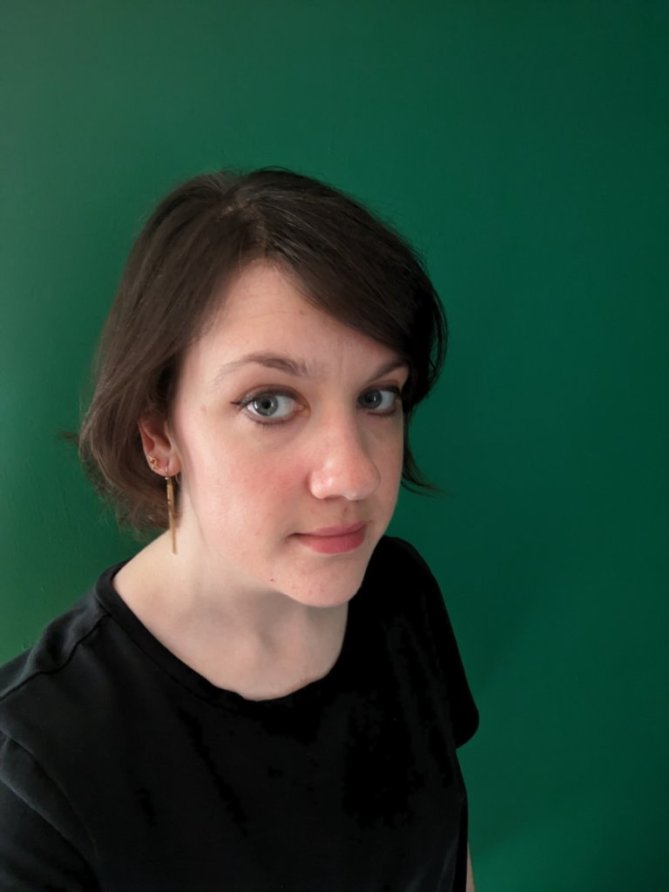
Hazel Zorn
Hazel Zorn works as an artist in the Northeastern United States. Visit hazelzorn.com for her fiction bibliography.